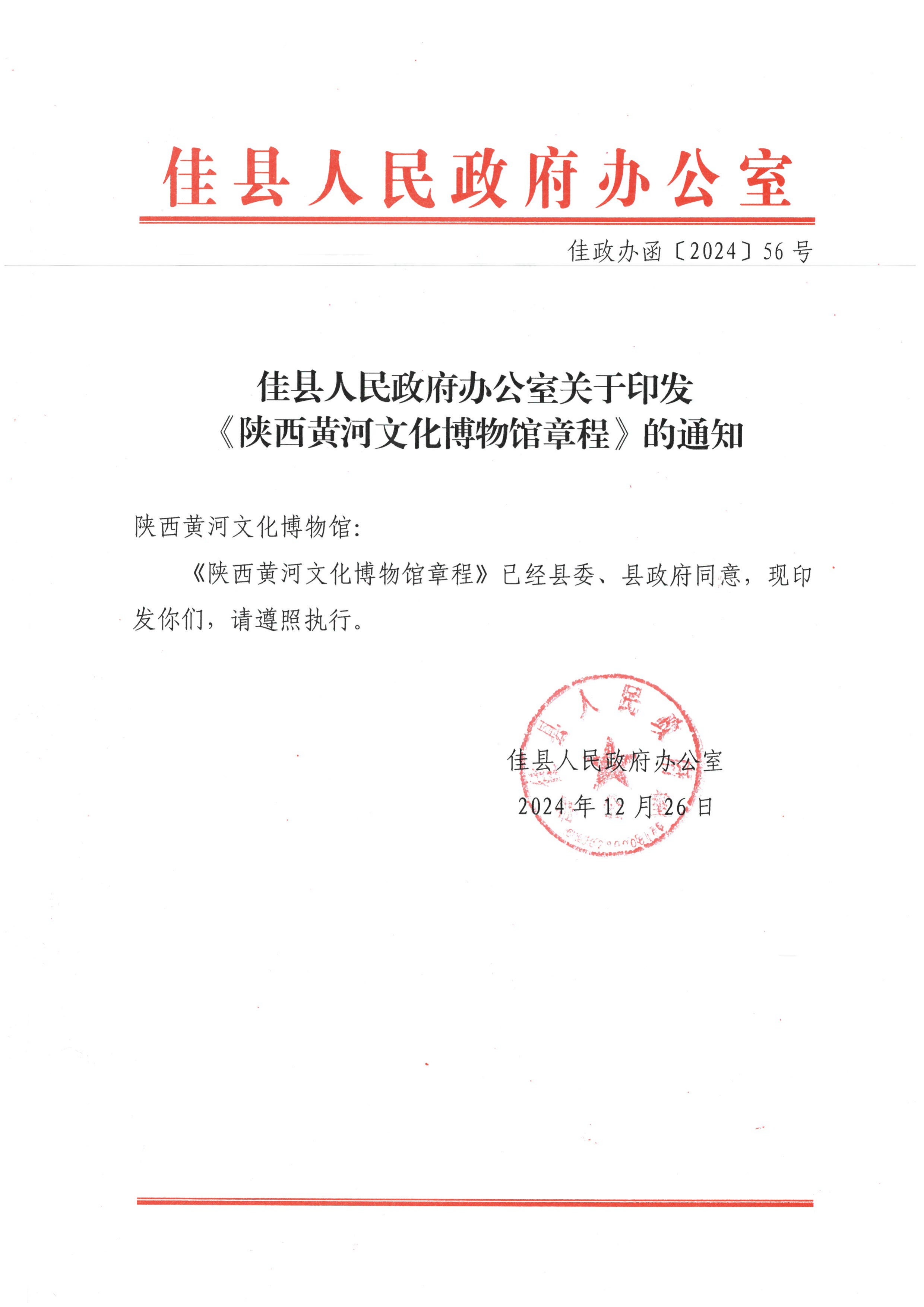
Shaanxi Yellow River Culture Museum
Table of contents
Preamble
Chapter I General
Chapter II Organizations and Decision-Making Mechanisms
Chapter 3 Collection Management
Chapter 4: Asset Management and Use
Chapter 5 Business Activities and Social Services
Chapter VI Termination Procedure and Asset Disposal
Chapter 7: Bylaw Amendments and Interpretations
Chapter 8 By-laws
The Preamble
As the mother river of the Chinese nation, the Yellow River carries thousands of years of geological change and human accumulation for thousands of years.
Three Qin Earth is located in the middle of the Yellow River. It is a central breeding ground, important heritage and typical manifestation of the Yellow River culture. Yulinjia County occupies the west bank of JinShaan Grand Canyon and sits on the northern edge of the Mauusu Desert. Since ancient times, it has been a key node in the Yellow River Basin agricultural culture, nomadic culture, intermixing commerce, and civilization. The opening of the Shaanxi Yellow River Culture Museum Province has successfully filled the gap of the Yellow River theme comprehensive museum, becoming an important cultural landmark for ecological protection and high-quality development strategy of the Yellow River Basin.
The museum is located in Shaanxi, Radiant Nine Domains and dates back thousands of years. It adheres to the core concept of "telling good stories of the Yellow River, inheriting the culture of the Yellow River and continuing the bloodline of the people."
In order to regulate the operation and management of venues, protect precious cultural heritage, practice public cultural mission, empower cultural heritage and innovation, manifest the core functions of museum collection, conservation, research, display, education and communication.
Yellow River Culture Museum of Shaanxi Province is the first time in the history of the Yellow River. It will continue to cultivate cultural roots, cultivate cultural resources, and expand communication boundaries. In the future, Yellow River Culture Museum will adhere to the principles of culture, cultivate cultural heritage, cultivate cultural heritage, and expand communication borders.
Chapter I General
Article 1 In order to promote the healthy development of the Shaanxi Yellow River Culture Museum, regulate the operation and management of the museum, further tell the story of the Yellow River, inherit the culture of the Yellow River, continue the national bloodline.
Article 2 The name of the museum is Shaanxi Yellow River Culture Museum (English name: Shaanxi Yellow River Culture Museum), located in Yulin City, Shaanxi Province. The site is http://www.sxhhwbwg.cn/page/index.html.
Article 3 The holding units are the CPC Jia County Committee, and the registration management authority is the Jia County Business Unit Registration Authority.
Article 4 The purpose of this museum: to adhere to the direction of serving the people, serve socialism and the principle of being close to reality, close to life, close to the masses, collect and protect human civilization and natural heritage in the Yellow River Basin, conduct research on artifacts and specimens in the Yellow River Basin.
Article 5 Scope of Business:
(1) Collect and store collections. Collect historical artifacts, folklore artifacts, revolutionary artifacts, literature materials, etc. to establish and improve the collection system.
(2) Display exhibitions. Organize permanent displays, temporary exhibitions and tours of the Yellow River culture, use a variety of forms to provide scientific, accurate and vivid display services, regulate the theme and content of the exhibition.
(3) Academic research. Excavate the historical, scientific and artistic value of the Yellow River Basin relics collection, carry out academic studies such as culture, cultural preservation, museumology, etc.
(4) Social education. Provide free and open public cultural services to the community, study, lectures, community building, volunteer service, etc.
(5) Culture and communication. Cultural and creative development around the Yellow River culture, create a visitor point for the Yellow River cultural influence, develop digital exhibitions, new media communications, non-relic theatres, live performances and other services.
Article 6 Sources of funding: Financial appropriation. The museum shall enjoy tax benefits according to law, and shall not be private, misappropriated or retained.
Article 7 The museum adheres to national laws and regulations and policies, adheres to the principles of public welfare, consciously accepts government regulation, industry self-discipline, social supervision and public comment.
Chapter II Organizations and Decision-Making Mechanisms
Section I Decision Making Body
Article 8 The council is set up as a decision-making body, responsible and reporting to the Yulin City Culture and Tourism Bureau, CPC Jia County Committee, each term for three years.
Article 9 The Council has 11 members, composed of organizers, representatives of experts and scholars, representatives from all walks of life, public representatives, etc.
Article 10 A member of the Council shall be elected for a term of three years per term, but shall not exceed two terms. The age of the members appointed by government departments is generally no more than 60 years, and the age of representatives of social persons is in principle no more than 65 years.
Article 11 Qualifications for the Board:
(1) Familiar with and comply with relevant laws and regulations of museums and national policies, possess the knowledge and ability necessary to perform the duties of a director;
(2) Enthusiasm for social good, love of liberal arts, willing to contribute to the museum's development, safeguarding its legitimate rights and reputation;
(3) Have good reputation in their field, can objectively express professional opinion, integrity and self-discipline;
(4) have full civil capacity, good health and can perform the duties of the director.
Article 12 The Board shall have a secretariat, located in the General Office of Museums, responsible for daily liaison, organization of meetings, minutes, draft documents and archival management.
Article 13 Main Duties of the Council:
(1) Develop and modify museum charters to clarify the museum's purpose, mission, development goals, business scope, etc.
(2) Consider the museum's development plan, annual workplan, annual budget and accounting report.
(iii) Consider the museum's important rules and programmes of major operations.
(iv) Oversee the museum's operational management and financial balance to ensure safe and effective use of museum assets.
(5) Coordinate the relationship between museums and government departments and all sectors of society to create a good environment for museum development.
(6) Oversee the management of the building, implement council resolutions, check implementation and correct irregularities;
(vii) Other significant matters that require consideration and decision by the Council.
Article 14 The meeting of the Council shall be held at least once a year. In case of major urgent matters, it may be proposed by the President, Vice-President or more than three members of the Council.
Article 15 The right of the Director: to attend meetings of the Board, have the right to speak, propose, vote, vote and be elected; to understand the operation of the Library and major decision-making matters; to consult relevant archive information; to advise and supervise the work of the Library; to propose a meeting of the Interim Council.
Article 16: Obligation of the Board to comply with these Bylaws and Council resolutions, faithfully perform their duties and safeguard the interests of the Museum; participate in meetings of the Board on time and related activities.
Article 17 A member terminates his or her membership if:
(a) the term of office expires;
(b) voluntarily resign and vote by the Council;
(3) two consecutive or cumulative three consecutive absences from a meeting of the Council without justification;
(4) Incapacitated in civil capacity, criminally liable or grossly discredited;
(5) unable to continue performing the duties of the director due to changes in work or health;
(6) Violation of the provisions of these Bylaws, harming the interest or reputation of the Pavilion.
Section II Executive Body
Article 18 The museum implements the supervision of Yulin City Culture and Tourism Bureau, under the leadership of the CPC Jia County Committee, the executive body consists of the curator, deputy director and other core managers.
Article 19 The director is appointed by the official representative of Yulin City Culture and Tourism Bureau.
(1) Organize council resolutions, preside over the management of daily operations and develop and implement annual work plans;
(2) Responsible for the establishment, hiring and management of staff training and improving professional literacy;
(3) Responsible for the implementation of core business such as collection, protection, display, research and so on to ensure the safety of collections;
(4) Responsible for the management of finance, assets and security, strictly implement the financial budget and regulate the use of funds;
(5) Organize cultural exchanges and cooperation at home and abroad to enhance the influence of the museum;
(6) To submit annual work reports, financial statements and requests for major matters to the Board.
(7) to conduct external liaison, sign relevant documents and perform the duties of legal representative;
(viii) Handle other duties of the Council and perform other duties as set forth in these statutes.
Article 20 The deputy director assists the curator in his work, according to the division of labor responsible for specific work.
21st management staff shall have the appropriate expertise and working ability, adhere to professional ethics, integrity and public duties in accordance with law, receive council, employee representatives and social supervision.
Section III Supervisory Authority
Article 22 The supervisory body of this unit is the Board of Supervisors, acting as a supervisory body.
Article 23 The total number of members of the Supervisory Board is proposed to be five, consisting of Yulin City Culture and Tourism Bureau, Jiaxian County Commissioners county government, social professionals representatives, public representatives, museum staff representatives, etc.
A member of the Supervisory Board shall be elected democratically by the members of the Supervisory Board to preside over the work of the Supervisory Board.
Main duties of the Board of Supervisors:
(1) Monitor the implementation of museum charters, check whether museum decision making and operation comply with bylaw provisions and relevant national laws and regulations.
(2) Oversee the work of the Board and management, examine the implementation of Council resolutions, the performance of management, and make recommendations for rectification of found issues.
(3) Review the museum's financial reports, budgets and accounting programs, monitor the authenticity, legality and effectiveness of financial balances, check asset management and prevent asset loss.
(4) Supervise major projects of the museum, bidding, implementation and acceptance, etc. to ensure that project specifications operate in accordance with relevant regulations and standards.
(5) Accept reports and complaints of violations by museum staff, investigate verification, make recommendations for processing.
(6) Regularly report to the competent authorities and councils on supervision work, submit reports of supervisory board work, make comments and recommendations on museum work.
(7) Perform other supervisory duties as stipulated by laws and regulations and museum charters.
Section IV Academic Research
Article 25 In order to promote the healthy development and prosperity of scientific research and academic work at the Shaanxi Yellow River Culture Museum, ensure independent conduct of related academic deliberations, consultation, planning and other work on the Yellow River Culture and Heritage Conservation, strengthen professional team building, enhance professional working level and social influence in the fields of cultural studies, display communication, heritage conservation, etc.
Article 26 Academic Committee is responsible for the development of academic planning, research and project management, academic activities and exchanges, business guidance and supervision, talent training and team building, academic supervision and complaint handling, public service and cultural outreach work.
Section 5 Friends of the Museum
Article 27 In order to promote cultural exchange, cooperation and innovation in the Yellow River, expand the space of cultural activities in the Yellow River, build bridges between museums and the public, gather social forces to participate in the conservation, research and dissemination of cultural heritage in the Yellow River.
Article 28 Friends of the Museum is a voluntary non-profit public welfare group, enjoy relevant rights and fulfill corresponding obligations in accordance with the Friends of the Museum Charter.
Section 6 Volunteer at the Museum
Article 29 In order to promote museum construction, enhance the function of social service, promote volunteer spirit, and provide volunteers with a diverse stage to realize social value and personal value, promote the comprehensive development of museums and individuals.
Article 30 Museum volunteers adhere to the principles of voluntary, unpaid, equality, integrity and norms, adhere to the principles of public welfare, serviceability, safety, respect history, respect artifacts and respect spectators.
Section 7 Staff
Article 31 The employees of this unit enjoy the right to pay for their labor according to law, social security and welfare, participate in democratic management.
Article 32 The employees of this unit shall comply with the laws and regulations of this unit, adhere to professional ethics and complete their work.
Article 33 This unit guarantees the legal rights and interests of employees in accordance with law, supporting employees to participate in business training, title evaluation and academic exchange.
Chapter 3 Collection Management
Article 34 The collection is the core basis for the performance of the function of the museum. The museum collects, collects, protects, researches and displays the collections according to law, strictly complying with relevant laws and regulations such as the protection of antiquities and fossil conservation of archaeobiotics.
Article 35 Collections shall adhere to the principle of legal, open and voluntary, obtained through purchase, acceptance of donations, exchange in accordance with the law and other lawful means.
Article 36 The museum establishes a sound collection management system, set up special storage places and professional custodial personnel, equipped with the necessary protective facilities equipment, and implement classification management of collections.
Article 37: Establish a complete collection account and archive, uniform numbering and registration of the collection. The collection belongs to artifacts, distinguish the class of artifacts, set up an archive separately, and report the antiquities authorities for filing.
Article 38 The protection of collections is responsible and regular inspection system. Regular maintenance of collection facilities and timely repair of damaged collections to prevent damage or loss.
39th collection display should meet the protection requirements, reasonable control of the display environment, light, temperature and humidity conditions, to avoid damage caused by display.
Article 40 Collection exchange, loan, transfer, disposal, etc. shall be considered and adopted by the Council and approved by the competent department of antiquities and related units. The collection of state-owned museum belonging to artefacts shall not be gifted, rented, sold to other units and individuals;
Article 41: Encourage all sectors of society to donate the collection to this museum, the museum gives recognition and thanks to donors.
42nd Collections managers must complete the collection transfer procedures before leaving office, ensure that collections accounts, files and physical match.
Chapter 4: Asset Management and Use
Article 43 The assets of the museum include fixed assets, liquid assets, intangible assets (names, brands, intellectual property rights, etc.) and other legal properties.
Article 44 Establish a sound asset management system, clear the process of asset registration, acquisition, use, maintenance, disposal and so on.
Article 45 Fixed assets acquisition, repair, disposal and other major matters must be considered by the Council and reported to relevant units for approval in accordance with the prescribed procedure.
Article 46 The funds of the museum shall be dedicated and uniformly managed, strictly implement the financial budget system, rationally arrange expenditure, strengthen financial accounting and supervision, ensure that the use of funds in accordance with the scope of business and career development needs set out in these bylaws.
Article 47 The museum strictly adheres to the financial management system, accepts financial supervision of departments such as finance, audit and cultural relics, regularly submits financial pre-accounting reports to the council, organizing units and related departments.
Article 48 The museum conducts cultural derivatives development, exhibition cooperation and other related business activities, must be in line with the purpose of the museum.
Article 49 The use and transfer of intangible assets in the Pavilion shall be considered and adopted by the Council.
Chapter 5 Business Activities and Social Services
Article 50 The museum adheres to the principle of public welfare, it is open to the public within 6 months from the date of obtaining the registration certificate, clear opening hours and notice to the society.
Article 51 Exhibitions are the core business of this museum. Permanent exhibitions should highlight the characteristics of the collection and geographical culture, the theme is clear, content science, temporary exhibitions should fit public needs, promote positive energy, comply with laws and regulations and social order.
Article 52 The museum strengthens its social education work and conducts personalized and diverse educational activities for different groups (adolescents, seniors, persons with disabilities, etc.), including instructional services, lectures, research practices, cultural experiences, etc.
Article 53 Establish a perfect system of explanation services, equipped with professional explainers, regulate the content of explanations, provide accurate and vivid explanation services, can provide multilingual explanations, accessible explanations and other services according to demand, convenient for public visits.
Article 54 Strengthen exchanges and cooperation with museums, scientific research institutions, cultural units at home and abroad, carry out exhibition tours, academic seminars, personnel exchange and other activities, introduce advanced management experience and high-quality exhibition resources to enhance the business level and influence of the museum.
Article 55 Promote digital construction, use online platforms, new media and other means to carry out online exhibitions, collections inquiry, cultural science and other services, expand the coverage of public cultural services and provide convenient and efficient cultural services for the public.
Article 56 Respect and safeguard the legitimate rights and interests of the audience, create a safe, comfortable and civilized visiting environment, equipped with necessary service facilities and accessibility facilities, publish complaints report telephones and mailboxes, deal with audience complaints and suggestions in a timely manner.
57th staff in business activities shall adhere to professional ethics, warm service and civil duty, shall not ask or receive audience goods, and shall not engage in for-profit activities unrelated to their work.
Chapter VI Termination Procedure and Asset Disposal
Article 58 If any of the following circumstances, it shall be terminated:
(1) Unable to continue business activities due to force majeure;
(2) The organization decides to terminate or cancel the organization;
(3) The registration authority revokes the registration certificate;
(iv) terminated by a resolution of the Council;
(5) Other circumstances under the law should be terminated.
Article 59 Before the end of this museum, under the guidance of organizing units, antiquities authorities and related units, a liquidation team is set up to carry out liquidation work.
Article 60 During liquidation, no business activities related to liquidation may be carried out and no collection or important assets may be disposed of.
Article 61 The disposal of assets after the termination of the museum, strictly in accordance with laws and regulations and relevant provisions:
Article 62 After the end of this museum, the disposal of the collection shall be reported to the antiquities authorities for approval and belonging to the antiquities, in accordance with antiquities protection laws and regulations.
Article 63 After the termination of this Pavilion, timely check-out procedures to the registration management authority, pay back the registration certificate and seal, and public termination information.
Chapter 7: Bylaw Amendments and Interpretations
Article 64 The amendment of this statute must be proposed by more than two-thirds of the members of the council, after consideration and adoption by the council, report the registration management authority and antiquities authorities for filing.
Article 65 The changes to this statute include:
(a) major changes in laws and regulations should be required to amend this statute;
(2) The name, location, organization and business scope change;
(iii) the composition and decision-making mechanism of the Council;
(4) Major problems arise in the management of the building, which need to be resolved by amending the Bylaws;
(5) Other cases where the statute needs to be amended.
Article 66 This statute shall be responsible for interpretation by the Council of the Pavilion, if the provisions of this statute contradict national laws and regulations and relevant policies, the laws and regulations shall prevail.
Chapter 8 By-laws
Article 67 This statute shall be considered and adopted by the Board of Directors.
Article 68 In accordance with national laws and regulations, relevant policies and industry norms, the Council may formulate appropriate implementation rules.
69th Article 6 copies of this statute shall be sent to registration authorities, antiquities authorities and holding units for filing.