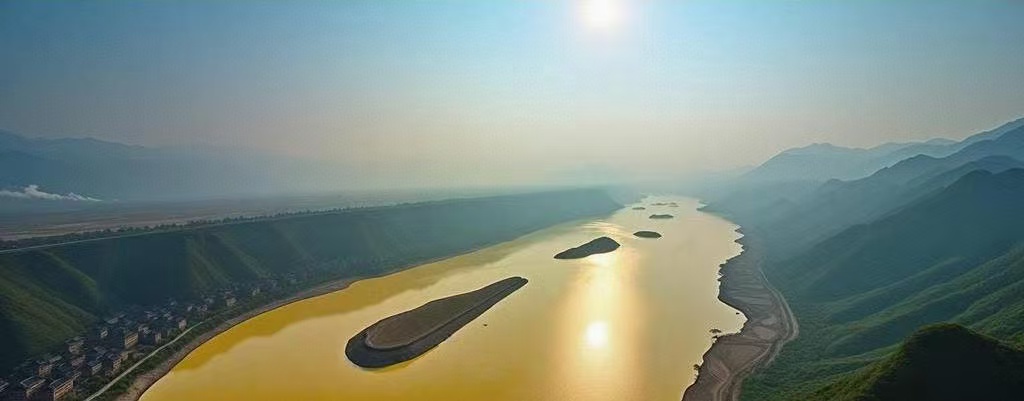
The Yellow River, the cradle of Huaxia civilization, the roots and soul of the Chinese nation. She folds back a thousand times, nine twists in series, she is majestic and mighty, she is alive and flowing forever. Tang poetry, the vastness of the sea, like the stars, is the peak of the development of classical poetry in China, but also the splendid treasure of the excellent traditional culture of our Chinese nation.
The Yellow River in Tang's poem
The Yellow River appears frequently in Tang poetry. Zhengzhou University's "Whole Tang Poetry Library" contains a total of 2,529 people's poems 42,8663 poems. Enter the word "Yellow River" in the Poem Library "Content Search" column. A total of 206 entries were found, divided into 100 authors, one of whom is unknown. Li Bai ranked first, followed by Bai Juyi, Gao Hui, Du Fu, Mengjiao, Yao He, Qishu, Li Shangyin, Liu Yuxi, Wang Changling, Ceng Zong, Li He, Jia Island, Wang Wei, Wang Zhiyu and others.
If you type the keyword “Yellow River”, you can find 208 sentences containing the word “Yellow River” in Tang Poems, 28 first sentences and 63 rhythm poems. Type the same keywords, you can retrieve 28 poem questions.
It is important to note that the search under the name "Yellow River" will inevitably be missed, because in the poet's pen, the Yellow River may be replaced by other names, such as river, big river, turbid river, etc., but whether they really refer to the Yellow River still needs to be checked. Therefore, it is necessary to find out how much of the Yellow River is in Tang poetry. In any case, Tang Poems, the Yellow River, once met in historical space and time, it was stunning years, brilliant starry sky. The river flowed freely in the poem, and the poem passed long on the banks of the river. The Yellow River fueled the pride of poets, who sang the spirit of the Yellow River.
The beautiful yellow river, beauty in its waves, beauty in its meandering, beauty in its rushing, beauty in its rigidity softness. As the late Tang poet Xue Neng wrote "Yellow River," "Where is Kunlun, even dry and soaked." Waves pass by geese, sound from the gantry. Shore cracks new, beach remnants fall.
The Yellow River in Tang
The Yellow River is written in Tang poetry, poets borrow water lyricism, Tohe words, this river has been given rich thought connotations, became a thousand years of immortal classic imagery.
In ancient Chinese literature, the word imagery was mentioned. Liu Qiwei in the Nan Dynasty had said that "the artist alone, to see images and get lucky". The Tang Dynasty poet and poet Shi Qittu also said: "Imaginary vision is strange." The famous Ming dynasty scholar, poet and literary critic, poet Hu should put it bluntly: "The beauty of ancient poetry, focus on imagery."
Li Bai, the most prominent Romantic poet in ancient China, is also one of the most well-known poets of folklore. He writes about the Yellow River, “Jun is not seen, the waters of the Yellow River come from heaven and run to the sea without coming back”, “The West of the Yellow River decide Kunlun, Roaring Miles touch Dragon Gate”. The poet, with great indignation, sketched the murderous face of the rebels, profoundly exposed the evil deeds of the separatist and secession forces represented by Anlu Mountain to destroy the unity of the motherland and trampled upon the Great Good River Mountains of the homeland. For example, “The whale caught the yellow river, chiseled the teeth of Tun Luoyang” (“Northern Diwali”), said Anshi rebels were like fierce whales against the people on both sides of the Yellow River. He wanted the Tang dynasty army to quickly flatten the rebellion, "General issued a white horse, should cross the Yellow River" ("from the Horse"), achieve a stable situation of "spring grass born yellow river", and determined to follow the Tang dynasty army "whipped away Ma Ling Huang River", fight An Shi rebels, reclaim the lower and lower part of the Yellow River occupied by the rebels.
According to the results of the search, he wrote three times directly about the Yellow River. These are not his representative works, but "the West Bank of the Yellow River is Wu Shu, the desire to supply the house without a poppy" and other sentences also deeply reflect the style of the era, clearly showing the thoughts of his sick and evil as enemies and worried people.
The two poems “Yellow River” are popular. “Yellow River” are full of people. In the daytime, the Yellow River flows into the sea. Wanting to be poor for a thousand miles, go up to the floor.” Only twenty words will describe the vast expanse of the Yellow River and endless stretches of the Yellow River.
When it comes to Wang Wei's "Make the Most Seized", people may immediately think of two of them: "The desert is silent, the long river falls in the sunrise". The picture is wide open and bright. Only a close-up shows the magnificence of the Yellow River swallowing sun and moon.
The Yellow River image of the Yellow River in Tang’s poem can be summarized as follows: “Water” sky is connected and “water” sky communion. Whether it is Li Bai’s “Yellow River comes from heaven”, or “Yellow River Water Comes From Heaven”, or “Yellow River Paradise”, or “Nine Qu Yellow River Wanlisha, Waves Windy Wind”.
It is a difficult and sad world. Life has been rough since ancient times, "Mo put Ajiao to this, it is hard to understand in the middle of heaven. To solve the Yin Han should have sung songs, only out Kunlun can not be understood." This is the poet Luo Yin to express the indignation and unevenness of the dark politics of the day by the Yellow River.
"The Yellow River is a thousand miles away, and the sky has gone to sea, deeply shocked poets." "You don't see the waters of the Yellow River coming from heaven, run to the sea again", "Yellow River West came to decide Kunlun, roaring thousands of miles into the Dragon Gate", "Yellow River raged through the heavens, loud and loud.
III. Conclusion
The Yellow River is composed of material and spirit, concrete and abstract. Through the artistic processing of Li Bai, Du Fu, Wang Zhiluo, Wang Wei, Wang Changling, Liu Yuxi and other people, it has powerful power.