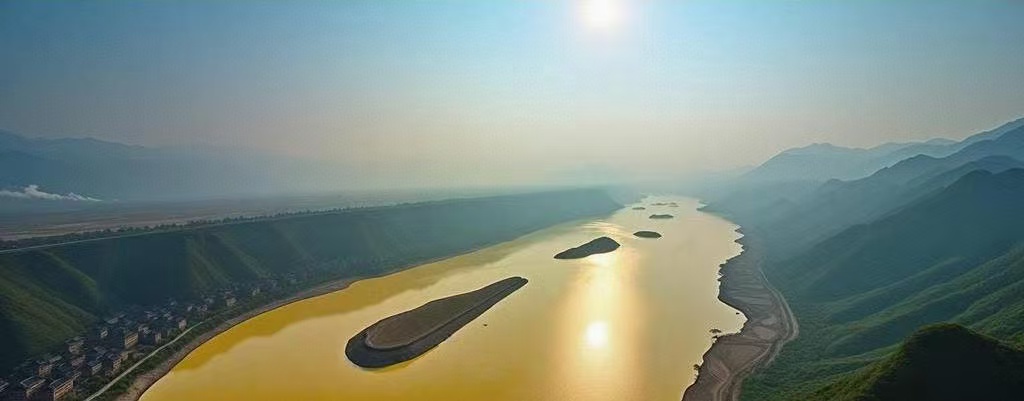
Yellow River water transport has a long history. The chasm opened by Wei Guo during the Warring States is the earliest man-made canal recorded in the Yellow River Basin.
In 339 BC, Wei Hui Wang decided to move the political center of Wei Guo from Anyi to Da Liang, near Kaifeng in present-day Henan. At that time, in order to use natural river lakes and develop water shipping, Wei Hui Wang renovated Putianze between Zhengzhou and Zhongmu in present-day Henan Province, making it a huge lake.
After 20 years, Wei Guo continued to chisel the southeast, so that the water system of the chasm continued to expand and eventually passed through Xu, Taikang, all the way to the south-east of Huaiyang to flow into the water and confluence into the Huai River. Since the chasm is based on the Yellow River as the source of water, with Putianze as a natural regulating reservoir, shipping water was guaranteed.
After the formation of the chasm water network, Wei Guo's boat from Da Liang can sail directly into Han, Chu, Wei, Qi, Lu, Song and other countries. With this huge transportation advantage, Da Liang in Wei Guo's capital leaped to become a commercial metropolis in the economically developed and rich north.
In the process of unifying China, Qin refurbishment of the Xian Qin Canal and opening a spiritual canal to connect two water systems, connecting the Yangtze River and Pearl River, expanding the canal shipping to Lingnan.
After Qin's death, Chu Han contended, and the Han army gradually gained the advantage of war. During the dilemma, Xu Yu took Liu Bang's father, Liu Taigong, hostage, and forced the Han army to sign a peace treaty.
Xihan Jiandu Chang'an, at this time, water transportation was mostly used to transport food, so it is called "Cao Transport". There are records: "River and Wei Cao took the world, West gave Jingshi", the scale and technology of water transportation has greatly improved.
However, at the end of the year, due to the drastic changes in the Yellow River, the river swings sharply southward, causing chaos in the Yellow River, Jishui, and Xianqu.
In 48 A.D., in order to solve the water supply of Luoyang City and develop the weave transportation, the court organized personnel in Luoyang City opened a canal around the city to the east.
The Yellow River in Henan
In 69 AD, Han Ming Emperor Liu Zhuang directed water conservancy expert Wang Jing to govern the Yellow River and Xiangu. Wang Jing absorbed the reasonable part of "Jajean Sancze", combined with the actual repair of the Yellow River embankment below Xiyang, rectified the river channel.
During the Weijin South and North Dynasty, the canal was mostly a product of military escapades, so the waterway military transport was more prominent.
In 202 AD, Cao Cao presided over the repair of the Xunyang canal. Guandu also used the chasm water source, and Guandu to Juyi section as a new channel. Below that, as far east as Yangyang is near Shangqiu in Henan Province, Dredging widen the riverbed after the Yangguo repair, providing favorable conditions for Cao Jun's defeat.
In 213, Cao Cao Cao, in order to improve the food and traffic conditions of his fiefdom capital, opened Licao canal from south to Guantao County, Hebei Province.
Cao Wei Daihan, Cao Cao Cao's second son Cao Pi Qiandu Luoyang. In order to facilitate transportation, successively reorganized and drilled between Huanghuai, Jiahouqu, Baima canal, Guangji canal, Huaiyang canal, Baiqi canal, Huaiyang canal and other water systems, more closely related to the Yellow River and Huaihe.
In order to improve Kyoto’s Luoyang and Guanzhong waterways, he organized manpower twice to overcome difficulties and obstacles. He repaired the Yellow River Threemen Gorges Beach in Shaanxi Province, and envisioned a “chiseling of Shannan Mountain, Duhe River, and Dongyu Lo-Lo-Liao-Liao-Liao-Liao-Liao-Liao-Liao-Liao-Liao-Liao-Liao-Liao-Liao-Liao-Liao-Liao-Liao-Liao-Liao-Liao-Liao-Liao-Liao-Liao-Liao-Liao-Liao-Liao-Liao-Liao-Luo-Liao-Liao-Liao-Liao-Liao-Liao-Liao-Liao-Liao-Liao-Liao-Liao-Liao-Liao-Liao-Liao-Liao-Liao-Liao-Liao-Liao-Liao-Liao-Liao-Liao-Liao-Liao-Liao-Liao-Liao-Liao-Liao-Liao-Liao-Liao-Liao-Liao-Liao-Liao-Liao-Liao-Liao-Liao-Liao-Liao-Liao-Liao-Liao-Liao-Liao-Lou-Liao-Liao-Liao-Liao-Liao-Liao-Liao-Liao-Liao-Liao-Liao-Liao-Liao-Liao-Liao-Liao-Liao-Liao-Liao-Liao-Liao-Liao-Liao-Liao-Liao-Liao-Liao-Liao-Liao-Liao-Liao-Liao-Liao-Liao-Liao-Liao-Liao-Liao-Liao-Liao-Liao-Liao-Liao-Liao-Liao-Liao-Liao-Liao-Liao-Liao-Liao-Liao-Liao-Liao-Liao-Liao-Liao-Liao-Liao-Liao-Liao-Liao-Liao-Liao-Liao-Liao-Liao-Liao-Liao-Liao-Liao-Liao-Liao-Liao-Liao-Liao-Liao-Liao-Liao-Liao-Liao-Liao-Liao-Liao-Liao-Liao-Liao-Liao-Liao-Liao-Liao-Liao-Liao-Liao-Liao-Liao-Liao-Liao-Liao-Liao-Liao-Liao-Liao-Liao-Liao-Liao-Liao-Liao-Liao-Liao-Liao-Liao-Liao-Liao-Liao-Liao-Liao-Liao-Liao-Liao-Liao-Liao-Liao-Liao-Liao-Liao-Liao-Liao-Liao-Liao-Liao-Liao-Liao-Liao-Liao-Liao-Liao-Liao-Liao-Liao-Liao-Liao-Liao-Liao-Liao-Liao-Liao-Liao-Liao-Liao-Liao-Liao-Liao
After the demise of Xijin, a large number of Central Plains people fled to Jiangnan and rebuilt the regime, known as Dongjin. In 369 A.D., Huan temperature led troops north fell before Yan, during the year of drought, Heshui and Jishui broke off flow, and commanded sergeants to open canals more than 150 kilometers to the south.
After the reunification of the Yellow River Basin, Bei Wei also paid attention to the cause of the Cao transportation. Especially after Luoyang, Bei Wei Qiandu, in order to pass through the Jianghuai and maintain southeast shipping, he built eight Cao transport transit stations, and tried to dredge the river channel in Longmen Gorge in the middle of the Yellow River to make it possible.
Yellow River Gorge
During the Weijin South and North Dynasty, people built a series of artificial canals on both sides of the Great River, improving their ability to navigate the river and develop weave transportation.
(From The Yellow River Story, Governance)
Disclaimer: Some of the information material is sourced from the web, content views are only for communication use, do not do any commercial use, copyright belongs to the original author.