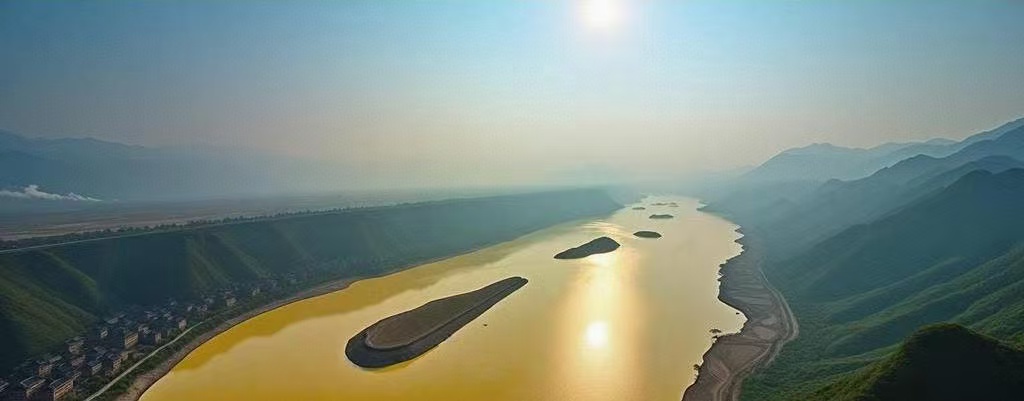
In the traditional human geography system, the Yangtze River, Yellow River, Huai River and Jishui are the main framework of the "four profanities" of the Yangtze River, Huang River, Huai River and Jishui.
In the East Han period, Bangu wrote "Hanshu Gou Chizhi" of the Huang River highly admired. The book mentions: "There are hundreds of Chinese sources, but there are four profanities in the river." This statement established the status of "four profanities" in the Yellow River.
Yellow River
The Yellow River flows through the Qinghai, Sichuan, Gansu, Ningxia, Inner Mongolia, Shaanxi, Shanxi, Henan and Shandong provinces (autonomous regions) with a total area of 752,443 square kilometers.
As early as spring and autumn, people called the Yellow River by "river". The poem Weifeng Vardan has: "Kan Kam Vardan, let the river dry. The river clears and ripens." The river here refers to the Yellow River, and at that time the river was flowing.
The Yellow River Basin, the root of civilization, is located in warm temperate zone and belongs to a continental climate of precipitation. After archaeological excavations, we discovered early humans such as Houdu Ape Man, Lantian Ape Man, Dali Ape Man, Xiangfen Ding Village, Shanxi.
The tomb was discovered in Xishui Slope, Huaiyang, Henan, where three servants were martyred. There are also traces of mass sacrifices on the outside, highlighting their identity. Dating back to the Bae Ligang culture period, eight thousand years ago, men became involved in agricultural production activities.
The Yellow River Basin, represented by the Central Plains, has been expanded through the integration of summer, commerce, and circumference, forming a distinctive yellow river culture. Qin Yijun, established the Huang River Culture as the main body, absorbing the northern nomadic culture and the Yangtze River Culture.
The development of the economy-based society promoted the progress of agriculture, handicrafts and commerce along the Huang region. People along the Huang region improved water conservancy, improved farm tools, revolutionized agrotechnologies, and led to the formation of the earliest cultivated agricultural areas.
In addition to the prosperity of agriculture, fine handicrafts represented by silk and porcelain have also been exported overseas. Among them, porcelain has become synonymous with "China". Through a series of initiatives such as business martinga transformation, the governance of Wenjing, Guangwu Zhongxing, Zhenguancun, Wang Anshi transforming method, etc., China's economy once led the world.
Science and technology torch economic development is inseparable from the support of science and technology. According to "Spring and Autumn", in 613 BC, "A Starb entered Beidou", this was the world's first recorded Halley's Comet. During the war period, the Ganshi Star Sutra became the world's earliest astronomical work.
The Yellow River culture is open and inclusive, widely absorbing the achievements of other fields, leading Huaxia civilization to keep moving forward.
In the spring and autumn period, along with Confucianism, Taoists, Mokists, Legalists, Famous Artists, Soldiers, Cross-Borders, Miscists and other schools of thought appeared colorfully, such as Lao Tzu, Zhuangzi, Argument, Meng Zi, Han Feizi, Sunbing Law and Lu Shi Chunqiu.
Xihan Dong Zhongshuo proposed "depose 100 families and honor Confucianism", the mainstream ideas of society gradually formed a political system based on "homeworld" as the core, the ethical system of "faithfulness" as the fundamental patriarchal system with "three syllabus and five regular" as the backbone of the patriarchal system.
In the process of growing and growing, Yellow River culture also actively spread its influence to the world. It spread far east, profoundly influenced North Korea and Japan, spawned historical events such as Keizi’s travel to the North, Xu Fudongdu and Tetang.
The Silk Road is the most important channel for foreign exchange. Chinese characteristics of porcelain, silk, tea, lacquerware, iron and other goods, as well as techniques such as papermaking, printing, gunpowder, horses in Central Asia, fur, melon fruit, spices, Roman treasures, Iranian silverware, Gandhara art, Buddhism in India, etc. passed into China.
With the Yellow River as its central axis, society, economy, technology and ideas like four-wheel drive together to propel the Chinese nation forward.
Source: Yellow River Culture in China
Copyright Notice: When reproducing original articles, please leave a message and indicate the source.