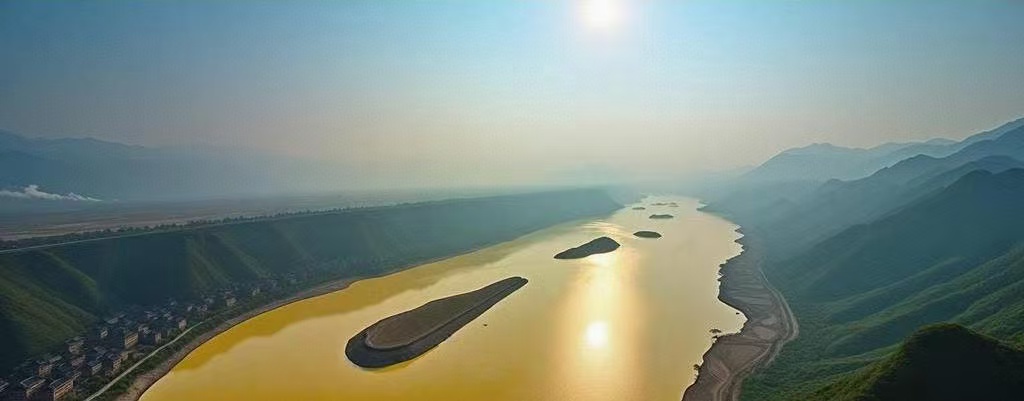
“You can defy everything, but not the Yellow River.” – Chairman Mao
The Yellow River is the mother river of the Chinese nation. Born in 1939, "The Great Chorus of the Yellow River", the symbolic method of writing the emotions of China's children and children to fight against the invaders, into a majestic and determined music.
The eight-way army created the mountain and the mountains.
In September 1937, the Eight Road Army held an oath division assembly in Shaanxi. From the Yellow River to the East of Shichuan Town, Hancheng City, Shanxi was the first stop on the front line of the Eighth Road Army.
After the eight-road army entered Shanxi, cooperated with the Kuomintang forces to wage fierce battles in Pingguan, Xinkou, Niziguan, Taiyuan, and won a local victory. After Taiyuan's loss, the defeated Kuomintang troops retreated to the southwest of Shanxi, taking Linfen as the center for consolidation. The Eight Road Army was tasked with the enemy's post-blocking mission in the east and southeast of Shanxi, and was commanded by Zhu De as the head of the East Road Army.
On February 25, 1938, Mao Zedong told Zhu De: "The enemy of Jinnan has entered the capital city and is close to Linfen. Its purpose is to attack Linfen, if it does not give annihilation, it is bound to cause a big picture. Mao Zedong and Ren Bi also advised the KMT authorities to "fight for the defense of Tongguan and Xi'an", and cautioned that troops north of the Yellow River should not cross the river even in the worst case scenario, but should insist on fighting in Jinxi Jinnan or foreign operations.
On February 28, after the safe transfer of Chinese and civilian forces in Linfen, the Japanese army was able to take over, and Zhu De had moved his troops into outer combat. However, the Japanese soon marched towards the Yellow River crossings, with attempts to cross the western part of the river.
As early as November 1937, Liu Shaoqi and Yang Shangkun proposed that all of our current work should be based on the victory of guerrilla warfare in North China. “If the Red Army is forced to retreat across the Yellow River, it will make my Party and the Red Army feel very difficult in every way, affecting the confidence of the people of North China in guerrilla war.” Mao Zedong told Zhu and Peng Dehuai in March 1938: "At this stage, without being fundamentally separated by the Japanese forces, our troops should fight resolutely behind the enemy, effectively eliminate and weaken the enemy, and launch a broad anti-Japanese campaign. As long as there is no danger of being isolated, we should never cross the river too soon." Zhu and Peng Dehuai made it clear that "we must not leave here at this time".
Yellow Riversha District provides a natural channel for the development of the Chinese Communist Party's anti-Japanese forces
The east-flowing Yellow River enters a gentle downstream stage in Taohuayu, Zhengzhou.
After the loss of Pingjin, Japanese troops marched south along Pinghan Road. In October 1937, they bombed Anyang County and invaded Henan territory. KMT forces blew up the Yellow River Iron Bridge between Xinxiang and Zhengzhou on February 17, 1938.
Under the brutal rule of Rikko, the Eight Road Army and local party organizations and guerrillas gradually developed into a stronghold of Jinji Luyu. This area is known as "In Heaven", connecting Taihang, Shandong and Huazhong to communicate north-south traffic.
The sand area is mainly located in the north of Yubei region, which is a large area of sand land between Puyang, Inner Huang, Qingfeng and other counties. The sand area can be opened as an underground traffic line, able to communicate with Ji Luyu, Ji Nan, Shandong, Subei and other anti-Japanese bases.
In the summer of 1942, the underground traffic line on North Road was formed. This traffic line escorted nearly a thousand passers by the party and political army for nearly a year. After the beginning of the whole wind in Yan'an, a large number of cadres and young students from Jiluyu, Shandong and Huazhong anti-Japanese strongholds were exchanged through this traffic line to Taihang and transfer Yan'an.
After 1943, the South Road Traffic Line escorted over 4,000 party cadres and young students, including Liu Shaoqi, Deng Xiaoping, Chen Yi and other important leaders such as Liu Shaoqi, Deng Xiaoping and Chen Yi.
Yellow River Sha District provides a natural channel for the development of the Communist Party of China's anti-Japanese forces, but also suffered from the madness of the Japanese army. The Japanese troops repeatedly "swept" around the area, resorted to combing fences and carrying out a "three light" policy, trying to cut off traffic lines led by the Chinese Communist Party.
Fully tap into the strategic value of Yellow Pan
On June 9, 1938, Chiang Kai-shek assigned the Kuomintang army to blow open the mouth of Zhengzhou Garden on the south bank of the Yellow River. The waters of the Yellow River spouted and spread over Yudongdo County, which had been occupied by the Japanese forces, once washed away Japanese supplies and damaged the Zipu and Longhai Railway lines.
Facing such complex hydrological and geological conditions, the Japanese had to abandon their original plan of attack. The KMT concentrated its forces in Zhengzhou and Yuxi and Yunan.
If we open the map, we will find that the Yellow Pan runs between North and Central China, providing a new base for the Chinese Communist Party. It can enable the eight-way army to move south when necessary, or it can open up new ground in areas where enemy and KMT control are weak.
On September 30, 1938, Peng Xuefeng led a team of 300 men to Yudong. After rendezvous with the local party organizations and guerrilla forces, the New Four Army Guerrilla Branch was formed. On October 24, the New Four Army Guerrilla Branch crossed the New Yellow River and opened the way of fighting in the Yellow Pan area.
Between 1942 and 1943, there was a severe famine in Henan, where the Japanese pseudo-military and Kuomintang forces controlled food in predatory ways and sought to weaken the Chinese Communist Party. By organizing local defenses, local organizations, protecting the local population, forming mutual aid groups, and establishing long-term ties with farmers.
In order to quickly solve the problem of North Sudan, Huang Kecheng, 115 division of the Eight Road Army, from Jilu Yu side of Shanxi, south to the emerging set and rendezvous with Pengxue Feng Division. Huang Kecheng also joined the Eight Road Army Sulu Yu branch from south Shandong, east to Yanfu area, and with Chen Yi division in Baiguan town, opened a 42,000 square kilometers, more than 8 million people.
With the spirit of perseverance, the Communist Party of China established a base in the lower reaches of the Yellow River under harsh conditions and fully exploited the strategic value of the Yellow Pan.
Mao Zedong once said, “You can defy everything, but you cannot defy the Yellow River. To defy the Yellow River is to defy our people.” From the Yellow Earth Plateau to the Central Plains, from the Huaibei Plains to the Yellow Sea, the Chinese Communist Party laid out anti-Japanese armed forces on both sides of the Yellow River like a strong iron chain that binds Japanese front lines and drags invaders into mire.
Author Profile: Yang Guang, Deputy Researcher of the CPC Central Party History and Documentation Institute
Source: Beijing Daily