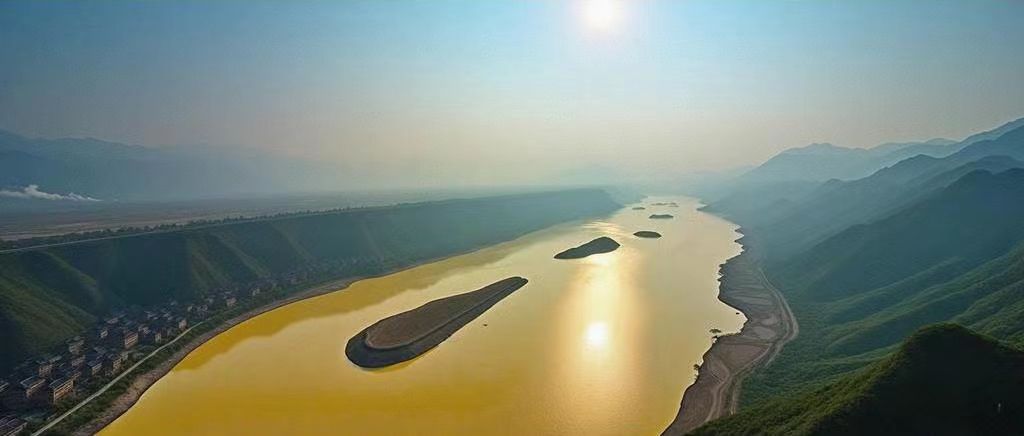
The Yellow River, the mother river of the Chinese nation, breeds a long-standing culture and splendid civilization.
On both sides of the Yellow River, there is a starry cultural heritage. A relic, a site that shows the diversity and inclusion of Chinese civilization, continues the story of the Yellow River.
View the Yellow River
The source is long and the deep.
In recent years, the excavations of the site have surprised archaeologists. The site is located in Lonan County, Shaanxi Province, a tributary of the Yellow River, and found more than 12,000 stone scrapers, choppers, hand axes, hand picks and other Paleolithic stone products.
Ancient humans worked here 1.1 million years ago, stretching back 30,000 years to a million years.
The Jiuqu Yellow River has carved out a huge "several" corner on China's land. It is diverse, wet climate, abundant flora and fauna resources, very suitable for the survival of the ancient Chinese people.
Pei Ligang is an ordinary village in the northwest of Xinzheng City, Henan Province. The “pei Ligang culture” was born here and is closely related to the Yellow River civilization.
This is a cookware ding unearthed at the Pei Ligang site in Xinzheng, Henan province (information photo).
The Yellow River, along with the Yangtze River, has nurtured the Chinese nation and bred Chinese civilization. In China's 5,000-year history of civilization, the Yellow River Basin has been a national political, economic and cultural center for more than 3,000 years.
Huangchengtai, the site of Shaanxi stone ruins (Aug. 6, 2022, drone photo). Photo by Zhang Bowen
He Zun, an early bronze ceremonial instrument from Xi Zhou, was unearthed in 1963 in Jiacun Town, Baoji City, Shaanxi Province. When antiquities workers cleaned up the speckled rust, he found a 122-word inscription on He Zun's inner bottom, which contained the words "Udzi China", leaving the earliest written record of the word "China".
Visitors visit He Zun, an early Western Zhou ceremonial instrument at the National Museum of China in Beijing (August 14, 2020)
In the long river of history, the connotation of "China" has evolved, developed and expanded from its original location. At the same time, Chinese civilization is like the water of the Yellow River, flowing all the way into a vast and endless flow.
The Yellow River Artifacts Bloom
From the original society of knife cultivation and fire, to the farming civilization woven by men and women; from the Yellow River chorus under the pagoda mountain, to the major national strategy for ecological protection and high-quality development...
Yinqiu, which is more than 3,300 years old, is the first documented and confirmed by archaeological excavations in China's history. Yinqiu and the oracles unearthed have been confirmed by the Shang Dynasty, advancing China's written history for about 1,000 years.
Tourists view the exhibition of Bcha at Yin Market Museum in Anyang, Henan (October 12, 2018). Photo by Xinhua News Agency reporter Ang Lee
As the most numerous archaeological excavations in our country, the longest duration and the largest exposed area of ancient capital city ruins, how to protect Yinqiu properly?
In October 2021, the revised "Anyang Yinqiu Protection Ordinance" was officially implemented, providing a more robust rule of law protection for the protection of Yinqiu. At present, the archaeology of Yinqiu Protected Area has been fully implemented.
In the provinces along the Yellow River, the protection of artifacts continues to strengthen and the foundation of antiquities preservation is continuously consolidated.
A 680-meter-long trestle of the Yellow River on the banks of Dujiazhuang, Shanxi Pinglu County, is a national key cultural relics protection unit.
“The ancient trestle is bearing the ingenuity of the ancient working people, witnessing the tenacity and tenacity of China’s sons and daughters.
Protecting cultural heritage along the Yellow River is not only a desire of people on both sides of the Yellow River, but also has become a major national strategy in our country. In July 2023, multi-sector jointly issued the "Preservation Planning for Construction of the Yellow River National Cultural Park."
Protect cultural heritage, along the Yellow River provinces in action:
The Yellow River flows through the town of Shuanghe in Linhe District, Bayan Naoer City, Inner Mongolia (drone photo, September 15, 2023).
In Inner Mongolia, in-depth conduct of archaeological excavations and heritage research in the Yellow River Basin, strengthen the identification of cultural relics and sanitary heritage archives, strengthen the preservation of ancient cities, towns, ancient villages, ancient potholes, ancient dodos and other heritage sites.
In Shaanxi, the Yellow River cultural heritage system protection works are being implemented, increasing efforts to protect and repair sites such as Zhouyuan, Qin Xianyang City, Han Chang'an City, Tongwan City, Daming Palace, Great Wall and other sites.
Cruise car drives past Danfengmen in front of Daming Palace National Site Park, Xi'an (Sept. 30, 2023, drone photo). Photo by Liu Xiao
In Gansu, Silver City relies on the construction of three major national cultural parks, the Long March, the Great Wall and the Yellow River.
This is Yongtai Ancient City in Temple Beach Township, Jingtai County, Gansu Province (July 11, 2023, drone photo).
The Yellow River story is not complete.
The Yellow River is ancient and modern.
Along the Yellow Highway, there are more than 50 natural and cultural landscapes such as Xiyue Huashan, Fengtu Yicang, Kekou Falls, Wubao Shicheng, etc.
Yan'an section of the Yellow Highway through Shaanxi in front of Yellow River Fusi Bay (August 9, 2017). Photo by Shao Rui, Xinhua News Agency
More than 800 kilometers along the Yellow Highway brings new opportunities for people living on the banks of the Yellow River.
Bailiang Town Chayu Village, Heyang County on the Huang River, is the last village to pass before the Xushui River, a tributary of the Yellow River.
With the opening of the Yellow Highway, Kyu Village shows its special advantages on the banks of the Yellow River. Now, it has grown red and red. The party branch secretary Lei Wuyi said that they are creating a cultural village along Huang with tourism leisure, folk culture, pastoral holiday and ecological experience.
In July 2022, the National Bureau of Antiquities and other departments issued a Planning for the Conservation and Utilization of Yellow River Antiquities. Multi-provincial districts along the Yellow River have successively introduced implementation plans and action guides to protect the artifacts of the Yellow River Basin and inherit the culture of the Yellow River.
With the gears turning, a fantasy tour begins: Fish Yue Dragon Gate, Igue Battle, Grotto Open Chisel, Flying Peony... Next to Longmen Cave Scenic Area, Longmen Ancient Street Experience Pavilion, visitors experience the beauty of Longmen Grotto and participate in colorful cultural cruises.
Tourists take photos during a tour of Longmen Grotto Scenic Area in Luoyang City (July 11, 2023). Photo by Xinhua News Agency reporter Lu Peng
In Shanxi Yungang Grotto, a large live performance called “See Yungang” was staged, with more than 1,000 people watching and nearly 1 million online. People were impressed by the beauty of traditional culture interpreted through modern art.
"See Yungang" large-scale live art show at Yungang Grotto (June 28, 2023). Xinhua News Agency (Photo courtesy of Yungang Institute)
In Xi'an City Wall, put on VR glasses, visitors can view the ancient city from "high sky", "hundreds of thousands like a chess game, 12th street like a vegetable" Tangcheng.
"Antiquities + Innovation" "Antiquities + Technology" "Antiquities + Tourism"... Antiquities and monuments spread across both sides of the Yellow River, come to the public in a younger and richer posture.
The Yellow River, which originates from the Qinghai-Tibet Plateau, is like a chain of brilliant beads that bind relics on both sides, shining brightly in the long river of human civilization.
"Running to the sea and not returning", today's Yellow River, with the spirit of enterprising inclusion, continues to write a new "Yellow River Story" of Chinese civilization.