Four thousand years ago, the wind swept through the Yellow River Basin, a pair of ceramic forged ears stood silent. Longshan Culture red pottery cup, with its thick and simple shape, carries the life code and spiritual totems of Neolithic ancestors - it is a practical tool, but also the footnote of early Chinese civilization.
The Three Finger Grip
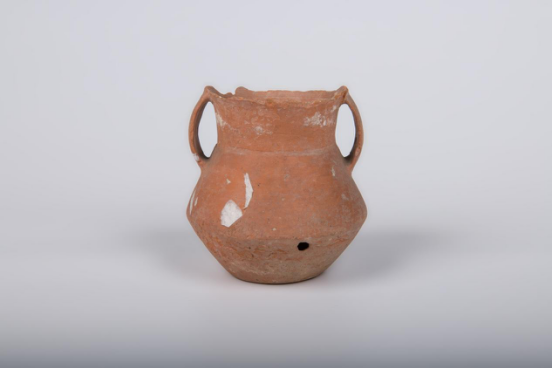
symmetrical distribution of the cup body, about 3 cm from the mouth (archaeological data). This design breaks through traditional pottery shape, easy to hold, carry and hang with rope.
The diameter 9 cm arc fits the arc of an adult’s palm, and the height of 12 cm makes up the ratio of force-saving lift.
The 6.2 cm diameter circle of the bottom contains mechanical wisdom, and the center of gravity is shifted down to ensure stability when fitted with a 7-min volume.
Simulations show that when the ear cup is full of liquid, adults can hold both hands without spilling and easily lift to the lips, a design thought that spanned 4,000 years.
Ritual Properties in the Red Tao Cup
The ochre-red fetus began to carry out a mission beyond the ordinary. The unearthed binaural cups at Sanlihe Tomb in Jiaoxian County were co-located with jade and tortoise armor. Some of the cup bottoms detected liquor residues, suggesting its special use in funeral rites.
Social Mirrors in Tomb Hierarchy
The highest-grade tomb in Sanli River (M267) was buried with four pottery cups, while small tombs appeared sporadically. This difference became evidence of the division of social stratification in Longshan, reflecting the strengthening of social stratification structure.
When the binaural cup moved from the living scene into the burial space, it became a material representation of the complex societies of the early Lower Yellow River.